
Dmitry Mariyasin
UNECE
Time to Deliver
Regional Action to Bridge the Climate Investment Divide
A fast-growing climate finance gap is putting the energy transition and global sustainability goals at risk. This article explores how UNECE and partners are tackling the challenge head-on, by turning pledges into pipelines of real projects, promoting just transition funds, and setting new standards that help make even small-scale initiatives investable, demonstrating the potential for practical regional action to unlock the capital needed to deliver on climate ambition.
The climate finance challenge
The gap between global climate ambition and the financial resources required to realise it is not only wide, but growing. Despite a steady stream of pledges and frameworks, the global system for financing sustainable development remains inadequate to meet the scale, urgency, and complexity of the challenge. A review of investment needs suggests that the financing gap for Sustainable Development Goal (SDG) related investments has grown from USD 2.5 trillion in 2015 to more than USD 4 trillion annually in 2024, both due to underinvestment and additional needs that must be urgently addressed.[1] While total available financing is increasing, it is not proportional with the rising investment needs, and the shortfall is only projected to continue expanding through to 2030.[2] In energy alone, the financing gap has doubled since 2015 and now accounts for roughly half of the total, with USD 2.2 trillion of the SDG financing gap tied to energy transition efforts.[3]
While the current figures are cause for concern, it is the accelerating nature of the deficit that is exacerbating the issue. The climate and SDG financing gap is expanding faster than current systems, institutions, and financial actors are willing or able to respond. It is not merely a matter of funding. Deep-rooted underinvestment in resilience, ongoing inequities in capital distribution, and a persistent mismatch between policy commitments and realised disbursements are driving the gap ever wider with each passing year.
Delays in investments in climate adaptation, disaster risk reduction, and nature-based solutions are escalating long-term financial needs. Every dollar invested in prevention can save up to USD 15 in post-disaster recovery,[4] yet global finance continues to skew heavily toward mitigation, neglecting the urgent need for proactive adaptation in the most vulnerable regions. Meanwhile, the global economy remains exposed to environmental shocks: more than half of global GDP is moderately or highly dependent on nature.[1] The rising economic costs of climate impacts are already visible. In the EU alone, extreme weather events caused €162 billion in asset losses between 2021 and 2023, representing nearly a quarter of all such losses since 1980.[5]
Finance is currently not flowing to the places and projects where it can have the greatest long-term impact. While high-level frameworks like the Sevilla Commitment, adopted at the Fourth International Conference on Financing for Development in 2025, are important in renewing political will, their success depends on structural reform. As the Sevilla process acknowledged, today’s international financial architecture is not fit for purpose as it cannot deliver the scale of capital needed, nor allocate it equitably or efficiently.
The challenge is not a global shortage of capital but getting capital to bankable climate projects in the right places, at the right time, on investable terms.
Mobilising Capital through Innovative Finance and Sustainable PPPs
The challenge is not a global shortage of capital but getting capital to bankable climate projects in the right places, at the right time, on investable terms. The United Nations Economic Commission for Europe (UNECE) has analysed the main reasons for the persistent shortfall in climate finance across its programme countries[a] and found three key obstacles:
- a misalignment and limited mutual understanding between project sponsors and investors;
- a high perceived risk environment in terms of political, economic, and commercial conditions;
- and the complexity of structuring suitable financing solutions in fragmented markets often characterised by smaller-scale projects.[6]
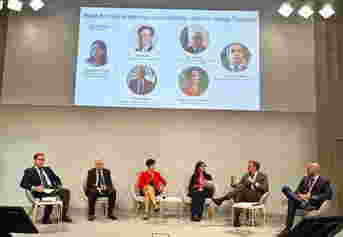
Sustainable Finance Forum (2024)
To address these barriers, UNECE partnered with the Climate Change High-Level Champions (Climate Champions) and over the past three years launched a set of initiatives aimed at connecting financiers and project sponsors with tangible investment projects. This work began with mapping priority transition projects and creating a global database of investors active in sustainable sectors. It has since grown into a regional pipeline of projects at various stages of maturity, each potentially matchable with tailored financing solutions, including seed capital, equity, debt, and insurance products.
In 2024, UNECE issued a public call for projects in its 17 programme countries: 245 climate projects were identified, filtered, and categorised according to their financial performance, business model, and impact on the Sustainable Development Goals (SDGs). From this pool, three standout projects were selected and presented at the Sustainable Finance Forum on 9 October 2024, co-organised with the Climate Champions, the European Commission, DZ Bank, ICC Germany and the Hamburg Chamber of Commerce, in the framework of the Hamburg Sustainability Conference 2024 (HSC).
The three projects, a battery factory, a novel cathode active materials plant, and a solar power plant, have already secured partial funding but are together seeking an additional USD 2.6 billion in financing to reach completion. Each of the projects and their sponsors also underwent training on the UNECE Public-Private Partnerships and Infrastructure Evaluation and Rating System (PIERS),[7] which evaluates public-private partnerships (PPPs) not only in terms of “value for money” but also in terms of “value for people” and “value for the planet”, providing a comprehensive framework to gauge their impact on achieving the SDGs. Applied from project outset and monitored across the full lifecycle, PIERS helps public and private partners strengthen sustainability performance and bankability of PPP projects. For governments, this framework strengthens project governance and accountability. For investors, it builds trust by signalling that risks are being managed not only in financial terms but also across social and environmental dimensions, which increasingly determine project viability and long-term returns.

HSC Future Economy Day 2025
Building on this, the Regional Platform for Climate Projects, developed in partnership with the Climate Champions, has now screened over 400 proposals, supported more than 40 projects with a combined value of USD 15 billion, and helped about 19 projects reach partial or full financial closing amounting to nearly USD 1.9 billion.[6] The three standout projects from Hamburg were also showcased at COP29 in Baku, giving them international visibility and strengthening their alignment with the global climate agenda. Endorsed by the COP27, COP28, and COP29 Presidencies and recognised in the Yearbook of Global Climate Action 2024, the initiative illustrates the effectiveness of a pragmatic, bottom-up approach by building bankable pipelines, standardising project assessment, and creating visibility for investors, as demonstrated again at this year’s HSC Future Economy Day, held in Hamburg on June 4.
UNECE is also supporting countries in embedding financing approaches directly into national strategies and just transition processes. In Serbia, for example, a forthcoming UN brief recommends, among other financing options, the creation of a National Just Transition Fund, capitalised by redirecting part of existing coal subsidies and allocating revenues from a proposed carbon tax.[b] The Fund would prioritise investments in workers retraining, SME development in green sectors, women’s green entrepreneurship, and infrastructure modernisation in coal-dependent regions. Closely linked to Serbia’s Nationally Determined Contributions (NDCs) and long-term low-emission development strategy, the Fund would be governed through an inclusive platform bringing together trade unions, employers, civil society organisations, women’s groups, and local authorities. In line with the UNECE Guiding Principles for Just Transition,[8] the platform would serve not only as a financing mechanism but also as a forum for participatory decision-making, capacity-building, and monitoring of social, economic, and environmental outcomes.
To complement these systemic financing efforts, UNECE has also advanced normative tools that address the structural barriers facing small and medium-scale climate projects. The UNECE Standard on Off-Grid Renewable Energy PPPs[9] provides guidance on how off-grid and mini-grid projects, which are often too small to attract commercial financing, can be structured through PPP models such as Build-Own-Operate (BOO) and Build-Own-Operate-Maintain (BOOM), combined with mechanisms like viability gap funding, guarantee schemes, and community participation. By offering clear frameworks for licensing, procurement, and asset registration, the Standard enables governments to aggregate multiple small projects into bankable portfolios that meet investor requirements, while delivering affordable, clean power to communities beyond the reach of central grids.
Together, these initiatives demonstrate how UNECE is tackling the financing gap at three levels: project pipelines, through practical matchmaking and investor alignment; national systems, through just transition financing mechanisms such as the Serbia example; and normative frameworks, through standards that de-risk and scale distributed projects. Embedding these efforts within strong governance and transparency allows blended finance instruments such as sustainability-linked loans, transition bonds, and local-currency green bonds, to be deployed with greater credibility and impact. This integrated approach addresses the climate investment divide by aligning profit with purpose and mobilising capital at the speed and scale required to meet the 2030 Agenda.

[1] UNDESA, 2024, Financing for Sustainable Development Report 2024: https://desapublications.un.org/publications/financing-sustainable-development-report-2024 (accessed: 13 November 2025).

Container for the dynamic page
(Will be hidden in the published article)